
/Antitech icon BW NB.png) Ichrak Eddor Mnijli
When a cyberattack affects the cold chain
A cyberattack can have consequences far beyond a computer screen. In the incidents described in this investigation, unauthorized access to supermarket refrigeration controllers allowed changes to the settings used to keep food cold.
The reported attacks affected hundreds of supermarkets in France in October 2026. CERT-FR identified compromises involving Danfoss AK-SM and AK-SC controllers and Copeland and Dixell XWeb systems.
This investigation is preliminary. The complete attack chain and the initial method of access have not been publicly confirmed.
One management system can supervise many refrigerators
A supermarket may use a central controller to monitor several refrigeration circuits. Staff and maintenance providers use its interface to check temperatures, manage alarms, schedule defrosting and change operating settings.
Someone who gains sufficient access to this interface may therefore affect several pieces of equipment without changing the software inside every refrigerator.
The management interface connects digital decisions to physical equipment.
Refrigeration control architecture
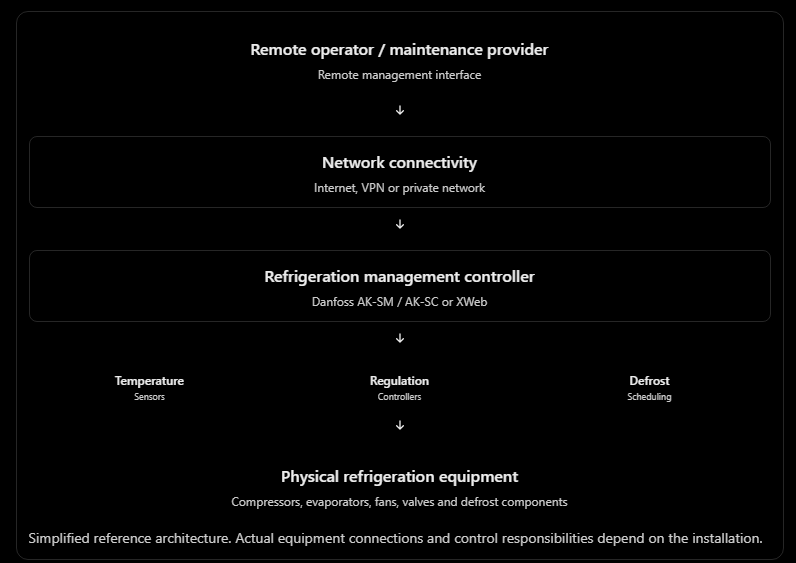
Simplified reference architecture. Actual equipment connections and control responsibilities depend on the installation.
What the evidence establishes, and what it does not
Public reporting describes unauthorized changes to refrigeration parameters and disruption of the cold chain. In one reported Dixell incident, a freezer's configured setpoint was changed from around -22?C to 150?C.
A setting of 150?C does not mean the freezer physically reached 150?C. Actual effects depend on the equipment, its control logic, how long the change lasted and any independent safety protections.
Changes to cooling, defrost schedules or alarm settings could make equipment fail to maintain suitable storage conditions. That creates a risk of food spoilage, operational disruption and financial losses.
Known software flaws are relevant, but do not prove the cause
In August 2026, Claroty Team82 documented three vulnerabilities in the Danfoss AK-SM 800A controller. They concerned an alternative authentication mechanism, operating-system command injection and web-server configuration injection. Danfoss addressed the documented vulnerabilities through a firmware update.
These findings are separate from the October incidents. Their existence does not establish that attackers used them in every affected supermarket, or even that they were the entry point in this campaign.
A further distinction matters: an attacker may not need to run arbitrary commands on the controller's operating system. Sufficient access to legitimate management functions can already allow dangerous changes to refrigeration settings.
How could many stores be affected?
The investigation considers three possibilities:
- Separate controllers targeted automatically. Many stores could expose similar management interfaces, allowing attackers to repeat an access method across independent installations.
- A shared maintenance provider compromised. Stolen service-provider credentials or access to centralized maintenance systems could potentially expose several customer installations.
- Different methods used against different systems. The incidents involved multiple controller families, so the same explanation may not apply to every store.
These are hypotheses, not established campaign mechanisms. Compromising one store's controller does not automatically provide access to every other supermarket.
Independent controller compromise hypothesis
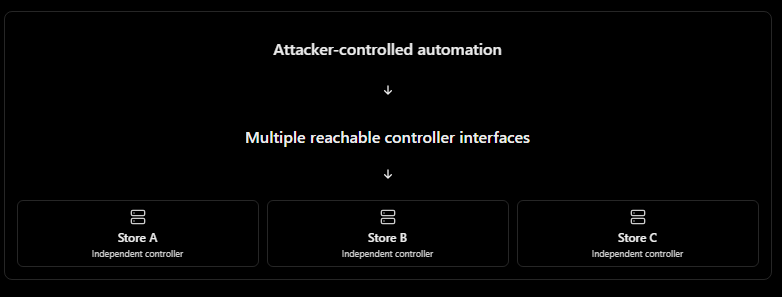
Working hypothesis only. This diagram illustrates how independently reachable controllers could be targeted; it does not establish the mechanism used in the reported incidents.
A valid login does not make every action safe
Authentication checks who may access a system. It does not necessarily establish that a requested change is safe for the physical equipment.
A compromised account may still submit a command that the software accepts, even when its physical effect is harmful. Broad administrative access can increase that impact. If the same interface controls both refrigeration settings and alarms, an attacker may also affect how problems are reported.
Independent safeguards and physical monitoring can reduce these dependencies. The investigation does not establish that every affected installation lacked such protections.
Protection needs to consider the physical context
Antitech's proposed approach is to add independent checks between remote management requests and physical execution. Such an architecture could combine asset discovery, protocol inspection, a policy engine, command enforcement, context monitoring, independent sensing and audit logs.
Example policies could require:
- Temperature setpoints to stay within approved operating ranges.
- Defrost changes to follow authorized maintenance procedures.
- Additional authorization for critical parameter changes.
- Investigation of repeated configuration changes.
- Independent alarms when actual temperatures exceed safe thresholds.
These are proposed safeguards, rather than a claim that one system can prevent every incident. A gateway can only block commands that pass through it. Alternative management paths and local access also need to be considered, and monitoring alone does not automatically restore safe refrigeration.
Keep reported facts separate from possible explanations
The central lesson is that access to a legitimate control interface can be enough to disrupt a physical process. Security needs to address both unauthorized access and the consequences of actions taken after access is obtained.
The complete forensic attack chain remains unconfirmed. The Technical version retains the detailed vulnerability discussion, reported behavior, evidence table and hypotheses from the supplied investigation.
References
Official Incident Reporting
ANSSI / CERT-FRhttps://www.cert.ssi.gouv.fr/alerte/CERTFR-2026-ALE-012
Technical Research
Claroty Team82 — Danfoss Controller Vulnerabilitieshttps://claroty.com/team82/research/freeze-the-controller-defrost-the-food-uncovering-vulnerabilities-in-danfoss-refrigeration-controllers
Danfoss Security Advisorieshttps://www.danfoss.com/en/service-and-support/coordinated-vulnerability-disclosure/danfoss-security-advisories/
Evidence limitation: The complete forensic attack chain remains unconfirmed. Hypotheses should not be presented as established incident facts.